AI can't replace artists, but it could make life easier
10.06.26
Share this


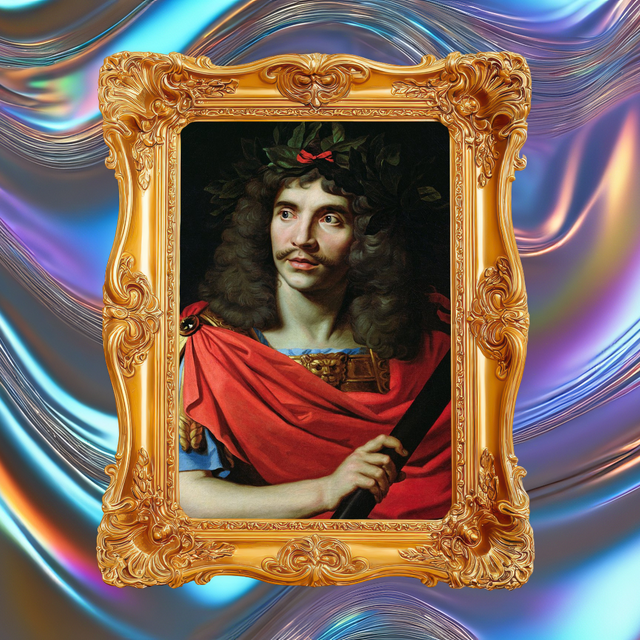
Following two performances of an AI-generated “Moliere play” in France, producer Paul Virides reflects on the impact of AI on the theatre industry, the meaning of creativity, and why we shouldn’t give up on humans just yet.
Part of our series reflecting on the state of AI in the arts, this blog post was initially posted on Paul’s Substack and has been republished here with Paul’s generous permission. You can read our initial piece by Lee & Thompson partners on AI control and consent within the arts here.
Paul is a theatre producer and general manager based in London, working mainly off-West End, at the Edinburgh Fringe, and author of a Substack about theatre producing.
I reacted with disdain when I initially saw that Molière’s l’Astrologue ou les Faux Présages was being staged at the Palace of Versailles.
Not because I dislike Molière — he’s great — but because he never wrote that play.
Rather, it’s been generated using AI — and then apparently “tweaked” by human artists — as an experiment in figuring out what he might have written next had he not died when he did. My disdain, it turns out, is for computers.
Artificial intelligence is infiltrating almost every part of digital life, which makes theatre one of the few bastions of definitely-human-made-art. Or at least, it should be. Creatives will have diverse and nuanced thoughts about this but most of us agree that AI poses a risk to the creative ecosystem, consuming and regurgitating pirated art without properly paying or crediting the original creators.
There’s another issue — frankly, a lot of AI-generated content is absolute dogshit. Not because it’s incompetent — that certainly can be true — but because it lacks any unique vision, voice or verve. I don’t think that will ever really change.
AI is no substitute for live performance. The most moving theatre is almost always the simplest; a person on a chair in a bare space will tear your heart out. Liveness and proximity is the whole point. As more and more screen work becomes artificial there’s a good chance that theatre becomes all the more attractive to the public as they seek something real.
That doesn’t mean AI won’t infiltrate and disrupt our sector. Some of this could be welcomed if it’s taking admin and menial tasks off individuals’ plates and leaving more space for work that necessitates a human touch. But using AI to simply replace creatives, though? No thanks.
I’ve heard the argument that someone creating art using AI is still an artist, that their vision as expressed through prompts is still a creation — a bit like an artistic director curating a season of work. Perhaps, but I think the difference is process. The experience of living life, wrestling with a project over weeks and months, and making choices about what to and not to include — that is what leads to good art. There’s a reason musicals often take a decade to perfect. Artistic directors might not be in the rehearsal room every day, but they spend a long time working out productions with creatives. It seems to me that the process is the very point.
As for me, I avoid it. If I just chose between three options presented by a chatbot when writing a budget or feeding back on a script, I would lose a lot of the confidence in the output. Emma Thompson has talked about her “intense irritation” with AI offering to rewrite her work; my experience of the very same thing is Microsoft Word trying to “correct” my contracts’ language — its suggestions have always been useless, fundamentally changing the meaning of the clause, and thus been ignored.
From a producer’s perspective it highlights the need to have a good legal framework. Most agreements for writers or designers already include a warranty by the artist that they’re not infringing on someone else’s copyright, but just try checking if that’s true. As legal challenges against software companies increase, we don’t yet know how they might impact consumers actually using the AI itself. Could someone “making” work generated by AI be sued for using someone else’s copyrighted material? (I’m reliably told — under Chatham House rules — that UK law is unlikely to result in this compared to US law, but it’s untested). And can we really trust AI not to pirate work we feed into it to use in future, even if it promises not to when we “opt-out”? In any case, there are some indications that the government is thinking about this.
I have a straightforward-sounding policy that I’m trying to stick to for moral rather than legal reasons: if you used AI to generate your work, I’m not working on it. That’s not the same as using AI to help you administrate it.
Even if you do want to create something with AI… Is it really necessary to use it to create plays written by long-dead playwrights? Anthony Horowitz didn’t need AI to write further James Bond novels, nor did Brandon Sanderson to finish The Wheel of Time, both after their original authors’ deaths. There would be nothing wrong with commissioning a living writer to make something “in the style” of Molière. Let’s not give up on humans just yet.
If you'd like to keep up to date with all our blog posts, important and interesting stories in the worlds of theatre, arts and media, plus job ads and opportunities from our industry friends, sign up to our daily media briefing at this link.
